


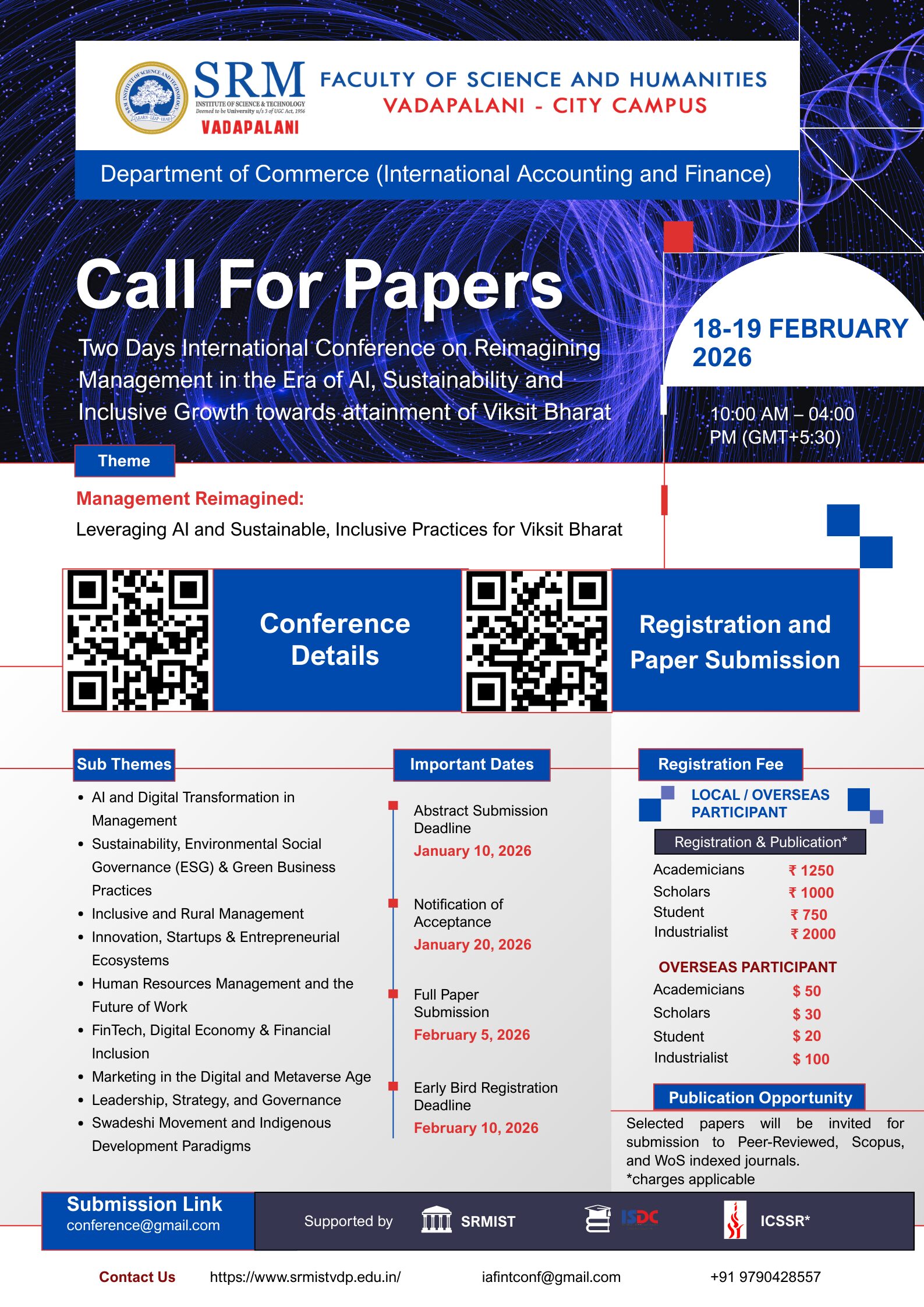
International Conference on Reimagining Management in the Era of AI, Sustainability, and Inclusive Growth towards attainment of Viksit Bharat
Concept Note :
In the era of Artificial Intelligence (AI), sustainability and inclusive growth are pivotal to achieving the aspirational vision of Viksit Bharat – a developed, self-reliant, and globally competitive India by 2047. In today’s rapidly evolving landscape, shaped by digital disruption, environmental challenges, and social inequalities, management theory and practice must embrace a transformative shift to remain relevant and impactful. The mixture of AI into business operations is revolutionizing decision-making, efficiency, and
innovation, yet it also raises critical concerns around ethics, job displacement, and data governance. Management must now adopt responsible AI frameworks that ensure transparency, accountability, and human-centric design.
At the same time, sustainability is no longer optional but a strategic imperative, urging organizations to integrate eco-conscious practices, reduce carbon footprints, embrace renewable energy, and align with Sustainable Development Goals (SDGs). The concept of Green Management, rooted in Arthashastra and traditional farming systems, offers valuable lessons for modern-day sustainability practices. Furthermore, inclusive growth must be embedded at the core of management models, recognizing the need to bridge
regional disparities, empower women and marginalized groups, promote digital inclusion, and strengthen rural economies through support for MSMEs, cooperatives, and social enterprises. This inclusive agenda is deeply intertwined with the Swadeshi ethos, which calls for indigenous innovation, promotion of local industries, and community-led development. By revisiting the principles of the Swadeshi movement self-sufficiency, ethical production, and local empowerment – India can foster management philosophy combining economic, social and cultural responsiveness. Education, especially management education, must also reorient itself to produce leaders who are not just skilled in global business trends but are also grounded in Bharatiya values, capable of driving innovation with empathy, purpose, and integrity.
In this reimagined framework, management evolves from corporate profit to transformative instrument (mechanism) for national development, blending technology with tradition, efficiency with equity, and profit with purpose. This holistic, integrative approach holds the key to navigating the complexities of the 21st century and ensuring that India’s journey towards becoming a Viksit Bharat is inclusive, sustainable, and deeply rooted in its civilizational identity and cultural wisdom.
Objectives:
- Critically examine the intersection of Artificial Intelligence, sustainability, and inclusive growth in reimagining management frameworks that support India’s transformation into a self-reliant and developed nation (Viksit Bharat), drawing philosophical inspiration from the Swadeshi Movement’s
emphasis on indigenous innovation, economic independence, and grassroots empowerment. - Foster academic and policy-oriented dialogue on leveraging AI-driven solutions and sustainable management practices to promote inclusive development, while upholding the core principles of the Swadeshi ethos, local production, self-sufficiency, and culturally rooted progress as foundational to India’s contemporary developmental trajectory.
Sub Themes:
AI and Digital Transformation in Management
- AI in strategic decision-making
- Robotic Process Automation (RPA) in operations
- Ethical and explainable AI in business
- AI and Human Resource Management (HRM 5.0)
- Smart factories and Industry 5.0
- Chatbots, virtual assistants & customer service
- Digital twins in production and project management
- AI for fraud detection and risk management
Sustainability, Environmental Social Governance (ESG) & Green Business Practices
- Triple bottom line reporting (People, Planet, Profit)
- Net-zero goals and decarbonisation strategies
- Circular economy and sustainable product design
- Social entrepreneurship and impact investing
- Environment Social Governance risks in investment decisions
- Climate finance and carbon credit trading
- Green marketing and consumer perception
- Water, energy, and waste management in industries
Inclusive and Rural Management
- Tech-enabled rural supply chain optimization
- Rural entrepreneurship through Self Help Groups and cooperatives
- Digital literacy and financial inclusion in villages
- Role of Corporate Social Responsibility in rural infrastructure development
- Micro-finance and women empowerment
- Agri-business models and precision farming
- Smart village frameworks and governance
- Policy and administrative innovation in rural development
Innovation, Startups & Entrepreneurial Ecosystems
- Lean start-up methodology and Minimum Viable Products
- Government schemes for start-up promotion (e.g., Start-up India)
- Entrepreneurship education and incubation models
- Deep-tech and climate-tech start-ups
- Crowdfunding and alternative capital access
- Institutional – Industry – start-up collaboration models
- Failures and pivots in start-up journeys
- Role of venture capital in emerging markets
Human Resources Management and the Future of Work
- Employee experience in hybrid work models
- Talent analytics and predictive hiring
- Digital upskilling and lifelong learning
- Work-life balance in gig economy
- Gen Z and Millennial expectations at work
- Diversity Equity Inclusion (DEI) strategies and unconscious bias
- Leadership in remote and distributed teams
- Employee mental health and organizational culture
FinTech, Digital Economy & Financial Inclusion
- Block chain in audit and compliance
- Digital lending platforms and credit scoring
- RegTech (Regulatory Technology) innovations
- Cybersecurity in financial services
- Central Bank Digital Currencies (CBDC)
- Embedded finance and super-apps
- Peer-to-peer lending and smart contracts
- Tokenization and decentralized finance (DeFi)
Marketing in the Digital and Metaverse Age
- AI-powered content creation and personalization
- Influencer marketing and social proof strategies
- Virtual reality (VR) and augmented reality (AR) in marketing
- Voice search and conversational commerce
- Consumer psychology in digital environments
- Metaverse commerce and avatar-based branding
- Brand activism and ethical consumerism
- Gamification in customer engagement
- Phygital Marketing
Leadership, Strategy, and Governance
- Strategic agility in VUCA environments
- Corporate governance reforms and board diversity
- Scenario planning and dynamic capabilities
- Purpose-driven leadership and business ethics
- Cross-cultural leadership and global strategy
- Behavioural governance and decision biases
- Family business strategy and succession planning
- Policy entrepreneurship and institutional innovation
Swadeshi Movement and Indigenous Development Paradigms
- Relevance of Swadeshi values in the digital age
- Indigenous knowledge systems and local entrepreneurship
- Self-reliant economic models and Aatmanirbhar Bharat
- Revival of local industries through innovation and AI
- Swadeshi-based Sustainable Development practices
- Rural self-sufficiency and grassroots governance
- Ethical production, consumption, and circular economy rooted in tradition
- Integration of cultural heritage into Modern Management Thought

Nhà cái QQ88 mang đến hệ sinh thái cá cược toàn diện gồm casino, slot, bắn cá và thể thao, phù hợp mọi đối tượng người chơi.
33WIN là thương hiệu giải trí cá cược trực tuyến uy tín hàng đầu châu Á, nơi hội tụ trọn vẹn những giá trị mà người chơi mong đợi: kho trò chơi đa dạng, bảo mật tuyệt đối, nạp rút siêu tốc và ưu đãi hấp dẫn mỗi ngày.
Thấy OK9 có nhiều người bình luận đúng kiểu fan bóng đá, đọc vui ghê
Grow A Garden: The Best Unlimited Tokens Script of 2024! https://gagtoken.surge.sh
Grow A Garden: Need Unlimited Tokens? This Script is for You! https://bloxhub.pythonanywhere.com
How are you?
**prodentim official website**
ProDentim is a distinctive oral-care formula that pairs targeted probiotics with plant-based ingredients to encourage strong teeth, comfortable gums, and reliably fresh breath
**aquasculpt**
aquasculpt is a premium metabolism-support supplement thoughtfully developed to help promote efficient fat utilization and steadier daily energy.
**mounjaboost**
MounjaBoost is a next-generation, plant-based supplement created to support metabolic activity, encourage natural fat utilization, and elevate daily energywithout extreme dieting or exhausting workout routines.
**herpafend official**
Herpafend is a natural wellness formula developed for individuals experiencing symptoms related to the herpes simplex virus. It is designed to help reduce the intensity and frequency of flare-ups while supporting the bodys immune defenses.
**men balance**
MEN Balance Pro is a high-quality dietary supplement developed with research-informed support to help men maintain healthy prostate function.
**prostafense reviews**
ProstAfense is a premium, doctor-crafted supplement formulated to maintain optimal prostate function, enhance urinary performance, and support overall male wellness.
Would love to constantly get updated great site! .
**neuro sharp**
Neuro Sharp is an advanced cognitive support formula designed to help you stay mentally sharp, focused, and confident throughout your day.
**boostaro official**
Boostaro is a purpose-built wellness formula created for men who want to strengthen vitality, confidence, and everyday performance.
Great information shared.. really enjoyed reading this post thank you author for sharing this post .. appreciated https://heosexhay.net/
This vibrant puzzle game is a real treat for the eyes and the brain! With its intuitive color-matching mechanics and increasingly complex levels, color rhythm offers hours of engaging fun. Perfect for quick sessions or longer, more challenging play. Highly recommended for puzzle enthusiasts!
**back biome**
Mitolyn is a carefully developed, plant-based formula created to help support metabolic efficiency and encourage healthy, lasting weight management.
QQ88 là cổng truy cập giải trí trực tuyến uy tín, giúp người dùng tiếp cận hệ sinh thái casino, slot, bắn cá và thể thao với giao diện mượt, tốc độ nhanh và trải nghiệm ổn định.
QQ88 là nền tảng giải trí trực tuyến được xây dựng nhằm tối ưu trải nghiệm người dùng, hỗ trợ truy cập nhanh, giao diện mượt và khả năng vận hành ổn định trên nhiều thiết bị.
Its such as you read my mind! You appear to know a lot approximately this, such as you wrote the e-book in it or something. I think that you simply could do with some percent to drive the message home a bit, however instead of that, that is fantastic blog. A great read. I’ll definitely be back.
This is now one of my favorite blog posts on this subject.
I love how well-organized and detailed this post is.
QQ88 là nền tảng giải trí trực tuyến uy tín, tối ưu tốc độ truy cập, giao diện mượt và trải nghiệm ổn định cho người dùng.
This topic really needed to be talked about. Thank you.
You clearly know your stuff. Great job on this article.
Thanks for sharing your knowledge. This added a lot of value to my day.
You always deliver high-quality information. Thanks again!
Khi đăng ký lần đầu và xác thực số điện thoại thành công tại F168, thành viên mới sẽ nhận quà trị giá 68.000 đồng.
QQ88 là nền tảng giải trí trực tuyến được tối ưu trải nghiệm, giúp người dùng truy cập nhanh, giao diện mượt và sử dụng ổn định.
naturally like your web site however you need to take a look at the spelling on several of your posts. A number of them are rife with spelling problems and I find it very bothersome to tell the truth on the other hand I will surely come again again.
Utterly pent content, thank you for information. “He who establishes his argument by noise and command shows that his reason is weak.” by Michel de Montaigne.
As I website owner I conceive the content here is really excellent, appreciate it for your efforts.
QQ88 cung cấp nền tảng giải trí trực tuyến ổn định, tập trung vào tốc độ truy cập, giao diện thân thiện và trải nghiệm liền mạch.
Sweet web site, super pattern, rattling clean and utilise genial.
After research a few of the blog posts in your web site now, and I really like your manner of blogging. I bookmarked it to my bookmark website listing and will be checking again soon. Pls try my website as nicely and let me know what you think.
You are my inhalation, I possess few blogs and infrequently run out from to brand.
Hi my friend! I want to say that this article is awesome, nice written and include approximately all vital infos. I would like to see more posts like this.
The other day, while I was at work, my sister stole my iphone and tested to see if it can survive a 25 foot drop, just so she can be a youtube sensation. My iPad is now broken and she has 83 views. I know this is entirely off topic but I had to share it with someone!
I enjoy the efforts you have put in this, appreciate it for all the great blog posts.
You got a very excellent website, Gladiola I found it through yahoo.
There is noticeably a bundle to know about this. I assume you made certain nice points in features also.
Great work! This is the type of information that should be shared around the internet. Shame on Google for not positioning this post higher! Come on over and visit my web site . Thanks =)
I truly enjoy reading on this internet site, it has superb blog posts. “The longing to produce great inspirations didn’t produce anything but more longing.” by Sophie Kerr.
It?¦s actually a nice and helpful piece of info. I?¦m happy that you shared this useful information with us. Please keep us up to date like this. Thank you for sharing.
It’s the best time to make a few plans for the long run and it is time to be happy. I have read this submit and if I may just I desire to suggest you few fascinating things or suggestions. Maybe you could write subsequent articles relating to this article. I want to learn more things approximately it!
I get pleasure from, result in I discovered just what I was taking a look for. You have ended my 4 day lengthy hunt! God Bless you man. Have a great day. Bye
I will immediately clutch your rss as I can’t in finding your email subscription hyperlink or newsletter service. Do you have any? Kindly allow me realize in order that I may subscribe. Thanks.
I’ve learn several just right stuff here. Certainly worth bookmarking for revisiting. I surprise how much effort you place to create this type of magnificent informative site.
Nice post. I be taught one thing more difficult on totally different blogs everyday. It would at all times be stimulating to read content from different writers and follow slightly something from their store. I’d choose to use some with the content on my weblog whether or not you don’t mind. Natually I’ll provide you with a link in your web blog. Thanks for sharing.
I appreciate you sharing this blog post. Thanks Again. Cool bro Slot Gacor
I appreciate you sharing this blog post. link gacor Thanks Again. Cool bro
Saya selalu tertarik dengan subjek ini dan tetap masih demikian, salam telah memposting.
Amat bersih situs internet, terima kasih untuk posting ini.
Yeah bookmaking this wasn’t a speculative decision great post! .
wow bro appreciate you sharing this blog post. link gacor Thanks Again. Cool bro nicee amazing
Isi yang berguna dan disajikan dengan sangat baik. Saya tentu akan membagikan ini kepada rekan-rekan. Terima kasih telah berbagi.
I appreciate you sharing this blog post. kampungbet link gacor terbaik
Terima kasih atas kritik yang masuk akal. Saya & tetangga saya baru saja bersiap untuk melakukan sedikit riset tentang ini. Kami sempat mengambil buku dari perpustakaan daerah kami, tapi saya rasa saya belajar lebih jelas dari postingan ini. Saya benar-benar senang melihat informasi fantastis dibagikan secara bebas.
Postingan yang sangat berguna. Saya baru menelusuri informasi seperti ini dan saya senang menemukannya di sini. Terima kasih banyak telah berbagi.
I’m truly enjoying the design and layout of your website. It’s a very easy on the eyes which makes it much more enjoyable for me to come here and visit more often. Did you hire out a developer to create your theme? Great work!
Howdy! This post could not be written any better! Reading this post reminds me of my previous room mate! He always kept chatting about this. I will forward this article to him. Pretty sure he will have a good read. Thank you for sharing!
Utterly written content, thanks for entropy. “Life is God’s novel. Let him write it.” by Isaac Bashevis Singer.
Terima kasih untuk artikel luar biasa yang lain. Di tempat mana lagi seseorang bisa mendapatkan jenis info seperti itu dengan pendekatan penulisan yang sempurna? Saya memiliki presentasi minggu berikutnya, dan saya sedang dalam pencarian informasi seperti ini.
obviously like your web-site but you need to check the spelling on quite a few of your posts. A number of them are rife with spelling problems and I find it very troublesome to tell the truth nevertheless I will certainly come back again.
Seseorang secara esensial membantu untuk membuat sangat artikel saya akan katakan. Itu adalah pertama kali saya mengunjungi halaman situs web Anda dan hingga sekarang? Saya terkejut dengan riset yang Anda lakukan untuk menyusun publikasi menakjubkan ini. Pekerjaan yang luar biasa!
Meski begitu, terima kasih untuk poin yang luar biasa ini dan meskipun saya tidak benar-benar setuju sepenuhnya, saya menilai pandangan.
Ini adalah topik yang sangat penting di hati saya, cheers, tapi di manakah detail kontak Anda?
Anda telah melakukan pekerjaan yang luar biasa dan seluruh komunitas akan berterima kasih kepada Anda.
Hmm apakah ada orang lain yang menghadapi masalah dengan foto di blog ini yang tidak mau dimuat? Saya mencoba mencari tahu apakah ini masalah di sisi saya atau blognya. Masukan apa pun akan sangat dihargai.
Thank you for sharing excellent informations. Your website is so cool. I’m impressed by the details that you’ve on this web site. It reveals how nicely you perceive this subject. Bookmarked this web page, will come back for extra articles. You, my friend, ROCK! I found just the info I already searched all over the place and simply could not come across. What a great web-site.
Seiring dengan hampir semuanya yang mana tampak sedang berkembang di dalam topik khusus ini, pandangan Anda umumnya sangat menstimulasi. Kendati demikian, saya maaf, tetapi saya tidak setuju sepenuhnya pada keseluruhan ide Anda, meskipun menggairahkan. Terlihat bagi saya bahwa pendapat Anda tidak sepenuhnya benar-benar rasional dan pada faktanya Anda diri Anda tidak benar-benar sepenuhnya yakin terhadap pernyataan tersebut. Dalam hal apa pun saya menikmati membacanya.
I was wondering if you ever thought of changing the structure of your blog?
Its very well written; I love what youve got to say. But maybe
you could a little more in the way of content so people could
connect with it better. Youve got an awful lot of text for
only having one or 2 images. Maybe you could space it out better?
Look at my web page – LESBIAN PORN SEX VIDEOS
F8BET là nền tảng giải trí trực tuyến được nhiều người dùng tại Việt Nam quan tâm, thuộc hệ thống phát triển bởi tập đoàn quốc tế uy tín. Thương hiệu này gây ấn tượng với kho trò chơi phong phú, giao diện hiện đại cùng nhiều lựa chọn giải trí hấp dẫn như dự đoán thể thao, trò chơi trực tuyến và nhiều hoạt động tương tác thú vị khác. Nhờ dịch vụ ổn định, trải nghiệm mượt mà và nhiều chương trình ưu đãi dành cho thành viên, F8BET ngày càng được cộng đồng người dùng tin tưởng lựa chọn.
Benar-benar jelas website, hargai untuk pos ini.
Terima kasih atas tulisan yang baik. Sebenarnya ini sebelumnya adalah sebuah akun hiburan. Terlihat maju menjadi jauh lebih menyenangkan dari Anda! Ngomong-ngomong, bagaimana kita dapat menjaga kontak?
Beberapa hari lalu, saat saya sedang bekerja, saudara perempuan saya mengambil iPad saya dan mengujinya apakah bisa bertahan dari jatuh setinggi 25 kaki, hanya agar dia bisa menjadi sensasi youtube. iPad saya sekarang hancur dan dia memiliki 83 penayangan. Saya tahu ini sepenuhnya di luar topik tetapi saya harus membagikannya kepada seseorang!
Saya sering blogging dan saya sangat menghargai konten Anda. Artikel ini benar-benar menarik perhatian saya. Saya akan mem-bookmark situs Anda dan terus memeriksa informasi baru.
Kami bisa memiliki hyperlink alternatif kontrak antara kita!
Bersama dengan segala sesuatu yang mana terlihat sedang dibangun di dalam topik khusus ini, pandangan Anda cenderung sangat menstimulasi. Walaupun begitu, saya memohon maaf, tetapi saya tidak dapat memberikan kepercayaan pada seluruh ide Anda, meskipun menggairahkan. Sepertinya bagi kami bahwa komentar Anda tidak sepenuhnya benar-benar tervalidasi dan pada faktanya Anda diri Anda tidak sepenuhnya pasti terhadap poin tersebut. Dalam hal apa pun saya menghargai membacanya.
Menikmati membaca keseluruhan ini, sangat bagus, terima kasih.
Hai, saya hanya ingin mengatakan bahwa saya sangat menyukai membaca postingan blog Anda. Ini adalah persis jenis informasi yang saya cari. Saya akan merekomendasikan ini kepada rekan-rekan. Terima kasih telah berbagi.
Saya tidak sangat mahir dalam bahasa Inggris tetapi saya menemukan ini amat mudah untuk dipahami.
Saya mengunjungi banyak website tetapi saya pikir yang satu ini punya sesuatu yang spesial di dalamnya
Saya umumnya tidak menulis komentar, tetapi yang ini benar-benar layak. Isi yang sangat baik dan berguna. Terima kasih banyak telah meluangkan waktu untuk menulis ini.
Perfect work you have done, this site is really cool with superb info .
Kemarin, saat saya sedang bekerja, sepupu saya mengambil iphone saya dan mengujinya apakah bisa bertahan dari jatuh setinggi 40 kaki, hanya agar dia bisa menjadi sensasi youtube. apple ipad saya sekarang hancur dan dia memiliki 83 penayangan. Saya tahu ini benar-benar di luar topik tetapi saya harus membagikannya kepada seseorang!
Saya melihat banyak website tetapi saya pikir yang satu ini punya sesuatu yang ekstra di dalamnya
Postingan yang hebat. Saya benar-benar menyukai gaya Anda menjelaskan ide-ide ini. Teruskan kerja yang luar biasa!
Nice post. I was checking constantly this weblog and
I am inspired! Very useful information specifically
the final section 🙂 I deal with such information a lot.
I was looking for this certain information for a long time.
Thank you and best of luck.
Terima kasih, saya baru-baru ini mencari informasi tentang topik ini cukup lama dan milik Anda adalah yang terbaik yang saya jumpai hingga sekarang. Namun, bagaimana dengan inti permasalahan? Apakah Anda positif tentang sumber tersebut?
Berharga informasi. Beruntung saya menemukan website Anda secara tidak sengaja, dan aku terkejut mengapa kecelakaan ini tidak terjadi lebih awal! Saya menandainya.
Saya tanpa henti memikirkan hal ini, terimakasih telah memposting.
Konten yang bermanfaat dan ditulis dengan baik. Saya tentu akan merekomendasikan ini kepada rekan-rekan. Terima kasih banyak telah berbagi.
Isi yang luar biasa! Saya akan kembali untuk membaca lebih banyak. Terima kasih atas berbagi ini.
Hmm apakah ada orang lain yang mengalami masalah dengan foto di blog ini yang tidak mau dimuat? Saya mencoba menentukan apakah ini masalah di sisi saya atau blognya. Saran apa pun akan sangat dihargai.
Saya secara tidak sengaja menemukan blog Anda dan saya perlu mengatakan bahwa saya sangat kagum. Teruskan pekerjaan yang hebat.
Can I just say what a reduction to search out somebody who really knows what theyre speaking about on the internet. You positively know easy methods to convey a problem to light and make it important. Extra folks have to read this and perceive this facet of the story. I cant believe youre not more in style since you definitely have the gift.
Sangat menarik poin yang Anda sebutkan, salam telah mengunggah.
Itu memang milik Anda! . Kita setidaknya perlu membuat orang-orang yang mencuri gambar ini mulai nge-blog! Mereka mungkin hanya melakukan pencarian gambar dan mengambilnya. Tapi tampilannya menarik!
Ketika saya awalnya berkomentar saya mencentang kotak -Beri tahu saya ketika umpan balik baru ditambahkan- dan sekarang tiap kali sebuah tanggapan ditambahkan saya menerima empat email dengan komentar yang identik. Apakah ada pendekatan Anda mungkin bisa mengeluarkan saya dari layanan itu? Terima kasih!
Sangat menarik informasi!Sempurna persis seperti yang saya cari!
Terima kasih atas kritik yang masuk akal. Saya dan tetangga saya baru saja bersiap untuk melakukan beberapa riset tentang ini. Kami sempat mengambil buku dari perpustakaan lokal kami, tapi saya rasa saya belajar lebih jelas dari postingan ini. Saya sangat senang melihat informasi hebat dibagikan secara bebas.
Biasanya saya tidak membaca posting di blog, tetapi saya ingin sekali mengatakan bahwa tulisan ini benar-benar memaksa saya untuk melakukannya! Gaya penulisan Anda membuat saya terkesan. Terima kasih, sangat artikel yang bagus.
Artikel yang luar biasa. Saya benar-benar menikmati cara Anda menyampaikan gagasan-gagasan ini. Teruskan kerja yang hebat!
Sangat jelas website, hargai untuk pos ini.
Hi, saya rasa situs Anda mungkin memiliki masalah kompatibilitas browser. Saat saya melihatnya di Safari terlihat baik-baik saja, tetapi di Internet Explorer tampilannya saling tumpang tindih. Saya hanya ingin memberi tahu Anda! Selain itu, blog yang fantastis!
Nyata jelas website, terimakasih untuk pos ini.
shbet nhà cái uy tín số 1 châu á 2026 . đăng ký ngay nhận lì xì 57k
The next time I learn a blog, I hope that it doesnt disappoint me as a lot as this one. I mean, I do know it was my option to learn, however I actually thought youd have something interesting to say. All I hear is a bunch of whining about something that you could repair for those who werent too busy searching for attention.
Ini adalah situs yang benar untuk siapa saja yang ingin mencari tahu tentang topik ini. Anda memahami begitu banyak hal sehingga nyaris sulit untuk berdebat dengan Anda (bukan berarti saya benar-benar ingin…HaHa). Anda benar-benar memberikan sudut pandang baru pada topik yang telah ditulis selama bertahun-tahun. Hebat, benar-benar luar biasa!
Saya melihat banyak website tetapi saya pikir yang satu ini punya sesuatu yang spesial di dalamnya
Trải nghiệm game tại ok9bet.net mượt mà, đa dạng thể loại và nhiều bonus cho người chơi mới
hi!,I love your writing so so much! percentage we keep up a correspondence more about your article on AOL? I need an expert in this area to unravel my problem. May be that is you! Taking a look forward to see you.
Some truly superb info , Sword lily I observed this.
hello!,I love your writing so so much! proportion we communicate more approximately your post on AOL? I need a specialist in this area to resolve my problem. May be that is you! Having a look ahead to look you.
Yeah bookmaking this wasn’t a speculative determination outstanding post! .
Saya menemukan blog Anda di Google dan memeriksa beberapa posting awal Anda. Teruskan pekerjaan yang sangat baik ini. Saya baru saja menambahkan RSS feed Anda ke pembaca berita MSN saya. Menantikan untuk membaca lebih banyak dari Anda nanti!
OK9 có nhiều game nên mỗi lần vào đều có cái mới để thử
Đỡ chán
Đổi gió liên tục
Test nhẹ đi nha 😆
OK9 có giao diện dễ nhìn nên dùng không bị rối
Gọn gàng
Dễ hiểu
Vào trải nghiệm nha 👍
Thấy OK9 dùng ổn trên cả điện thoại nên khá tiện
Linh hoạt
Mượt ghê
Tải thử đi 📱
Seseorang secara esensial memberikan bantuan untuk membuat secara signifikan posting saya mungkin katakan. Ini adalah pertama kali saya mengunjungi halaman web Anda dan hingga kini? Saya terkagum dengan riset yang Anda lakukan untuk menyusun publikasi luar biasa ini. Proses yang luar biasa!
Sangat menarik info !Sempurna persis seperti yang saya telusuri!
Wow! Blog ini terlihat tepat seperti blog lama saya! Topiknya sangat berbeda tetapi memiliki tata letak dan desain yang hampir sama. Pilihan yang hebat!
Luar biasa! Blog ini terlihat persis seperti blog lama saya! Topiknya sangat berbeda tetapi memiliki tata letak dan desain yang hampir sama. Pilihan warna desain yang hebat!
Tulis lebih banyak, hanya itu yang ingin saya katakan. Secara harfiah, sepertinya Anda mengandalkan video untuk menyampaikan poin Anda. Anda jelas tahu apa yang Anda bicarakan, mengapa menyia-nyiakan kecerdasan Anda hanya dengan memposting video ke situs ketika Anda bisa memberi kami sesuatu yang informatif untuk dibaca?
Permalink
Mình đã chơi thử một thời gian tại https://spel.us.com/
và thấy CM88 có kho game khá đa dạng, từ cá cược thể thao, slot đến casino trực tuyến. Điểm mình thích là hệ thống vận hành ổn định, không bị lỗi giữa chừng khi đang chơi – đây là yếu tố quan trọng với dân chơi lâu năm . Ngoài ra, việc nạp rút cũng tương đối nhanh. Tuy vậy, anh em nên đọc kỹ điều khoản trước khi tham gia các chương trình thưởng để tránh hiểu nhầm.
Vào OK9 lúc rảnh thấy giải trí khá hiệu quả
Chill nhẹ
Thoải mái
Anh em vào thử 👉
Mainkan Bandar Slot Gacor terpercaya dengan peluang menang tinggi dan nikmati berbagai game slot popular dengan bonus besar melimpah. Daftar sekarang dan raih peluang jackpot besar setiap hari!
F8bet (hay F8 BET , F88BET) cổng game giải trí số 1 Việt Nam 2026 với nhiều khuyến mãi hấp dẫn. Trải nghiệm ngay để nhận lì xì vs code khủng
Hai semua, saya menjumpai website Anda melalui Google saat menelusuri subjek yang sebanding, blog Anda muncul di posisi atas. Saya harus mengakui bahwa saya kagum betapa bagus penyusunannya. Saya sangat menikmati membaca ini dan saya akan kembali untuk melihat konten lainnya. Terima kasih!
Permalink
Permalink
Saya terus-menerus melihat online untuk ide yang dapat memfasilitasi saya. Terima kasih!